TikTok mass report bot: the numbers TikTok publishes and the sellers never cite
Short answer. A TikTok mass report bot files bulk automated reports at one account, video or LIVE session. It does not produce a ban. TikTok removed 184 million videos in the first quarter of 2026 and found 99.3% of them before any user reported them, so report volume competes for a fraction of enforcement. TikTok’s harassment rules then treat organised false reporting as the violation.
Two sets of evidence exist on this question, and only one of them is published. Panels advertise a price per thousand reports, delivery in hours, and an enforcement rate in the high eighties. TikTok publishes a quarterly enforcement report giving the removal counts, the share found by automation, and the number of its own decisions it reversed.
Setting the two beside each other takes about ten minutes and settles most of what follows. Whether to buy a tool, whether the open-source build is safer, what to do when a campaign lands on your account — each resolves differently once the removal figures are on the table.
What is a TikTok mass report bot?
A TikTok mass report bot is software or a paid panel that submits many policy reports against one target inside a short window. TikTok mass reporting is the practice itself: a group, a script or a purchased queue driving complaint volume at one account, on the theory that a large enough pile forces a review. The bot automates only the submission step.
The builds differ in packaging rather than in function. A public repository drives a browser session and needs the operator’s own login. A hosted panel hides that behind a checkout page and a progress bar. A mass report bot TikTok sellers describe as “undetected” is doing the same four taps a person would, faster.
Every one of them stops at the submit button. What decides the outcome happens after that, inside a moderation pipeline no buyer can see, and a mass TikTok report bot has no access to it.
Does mass reporting work on TikTok?
No. TikTok assesses each report against the specific Community Guideline the reporter names, and decides the case on the content rather than the count. The published enforcement data makes the reason concrete: almost all removals happen before a report exists at all, which means reports of any volume are competing for a small remainder of the platform’s enforcement capacity.
TikTok removed 184,012,576 videos worldwide in the first quarter of 2026, about 0.5% of everything uploaded. Automated detection accounted for 178,014,154 of them, and the proactive removal rate — content removed before any user report — was 99.3%.TikTok Community Guidelines Enforcement Report, Q1 2026 (January–March 2026).
Run the subtraction. Automation took 96.7% of the removals, leaving 5,998,422 videos for every other route combined. The proactive rate narrows it further: 0.7% of 184,012,576 is roughly 1.29 million videos in three months where a user report preceded the removal. That is about 14,300 videos a day, across every language and market TikTok operates in.
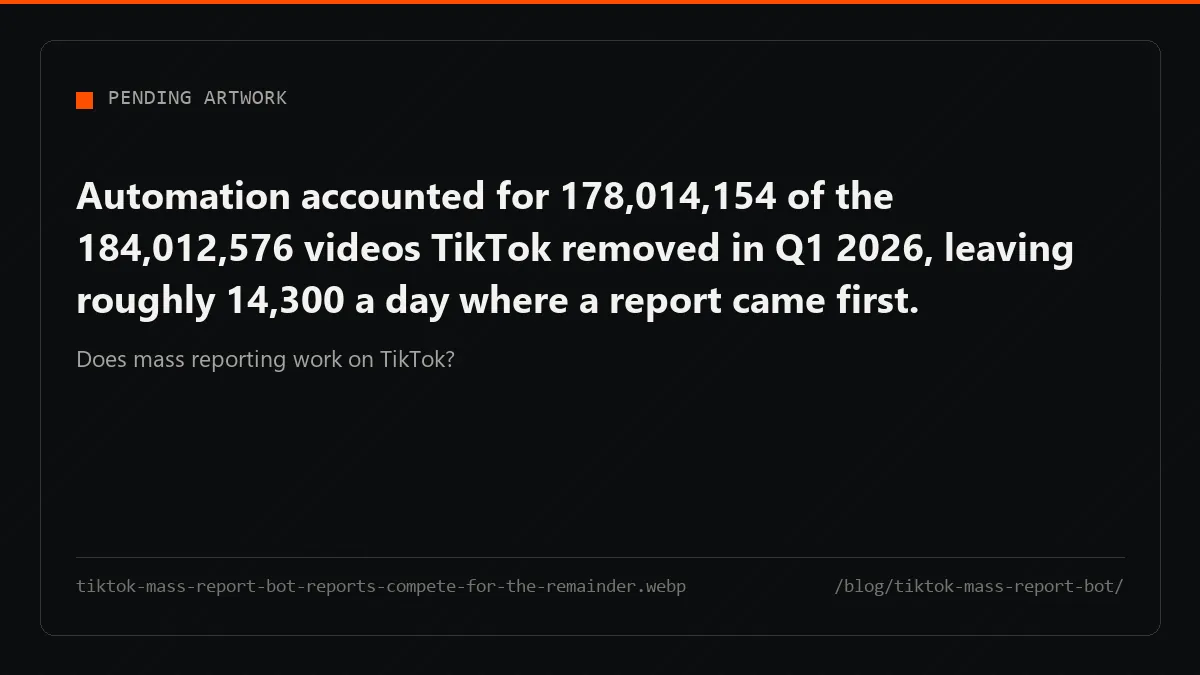
Every report on the platform competes inside that 1.29 million. A mass report TikTok campaign adds submissions to a queue whose decisions were already 99.3% settled by classifiers, and adds nothing to the evidence those decisions turn on. The same question on Facebook resolves through a strike ladder rather than a complaint tally, which is the subject of what Facebook counts instead.
Where mass reporting TikTok accounts appears to work
Accounts do vanish shortly after a wave of complaints, and the wave takes the credit. Usually the account was posting recycled scam links, stolen video or a copied identity — material TikTok’s classifiers reach on their own, and reached in 178 million other cases that quarter. The campaign and the removal share a cause.
When the target is compliant, the outcome is uniform and invisible. Reports close with no action, TikTok shows an account nobody’s complaints against it, and the buyer is left with a vendor dashboard as the only evidence anything was filed. Verification is structurally unavailable to the person paying, which is the condition every claim in this market depends on. The same unverifiable structure runs through the X ban service market.
What a mass report tool or service actually sells
A TikTok mass report tool sells submissions by the thousand and a TikTok mass report service sells them by the target. Neither price attaches to an outcome the seller controls. The listings below were recorded from live pages on 4 August 2026, and the pattern is consistent enough to tabulate.
| Advertised term | What the listing states | What it implies |
|---|---|---|
| Panel rate | $0.99 per 1,000 reports on one panel; “from $0.26” on another | $0.00099 a report — below the cost of the logged-in session each report needs |
| Tiers | 10 to 10,000 reports, bulk discount rising to 67% at the top tier | The tier buys a quantity of clicks, not a quantity of review |
| Delivery claim | “Results in as little as a few hours” | TikTok publishes no review time for user reports, so the window has no source |
| Guarantee | Satisfaction guarantee, refund via 24/7 support | Refundable on delivery of reports, which is the part that was never in doubt |
| Payment | Cards and wallets on panels; crypto or gift cards on private sellers | The crypto tier is the one with no chargeback route |
Terms quoted from two live report-selling panels, accessed 4 August 2026. The pages are deliberately not linked here.Vendor sales copy, recorded 4 August 2026.
The arithmetic is where the offer comes apart. At a tenth of a cent, nobody is maintaining the aged accounts, residential proxies and human sessions that filing from a credible profile would take. What a mass report TikTok tool delivers at that price is API calls or nothing.
Private sellers price the same mechanism differently. A mass report TikTok bot rented by the month, or a managed campaign quoted per target after a free “case assessment”, moves the invoice without moving the submit button anywhere nearer the decision. The full price ladder for that managed version is set out in the TikTok ban service breakdown.
Buy, APK, online, GitHub, Reddit: five searches, one product
The market behind these phrasings is smaller than the search volume suggests. Buyers rephrase the query looking for a version that is verifiable, and the results return the same five shapes. This audit records what each returned in August 2026.
| What people search | What the results actually are |
|---|---|
| tiktok mass report buy | SMM panels quoting per-thousand rates alongside follower and view packages |
| tiktok mass report bot apk | Sideloaded builds requiring a TikTok login inside the app itself |
| tiktok mass report bot online | Hosted dashboards with a progress bar and no case reference |
| tiktok mass report github | Repositories, topic pages and sandbox mirrors, several used as storefronts |
| tiktok mass report bot reddit | No forum thread ranks at all — the modifier looks for buyer verification the results do not contain |
The last row is the most useful finding on this search. Adding “reddit” to a product query normally surfaces people describing what they paid and what arrived; here it returns the vendor set again. A TikTok mass report bot github listing has the same gap in a different costume: a repository is code, not a record of an enforcement outcome. The panel version of the same product, sold against Telegram, is taken apart in what a Telegram panel sells.
One pattern is worth naming separately because it inverts who the victim is. A TikTok mass report bot apk or repository needs an authenticated session to file anything, so it asks the buyer to log in. That request is the product. A build collecting TikTok credentials is an account-takeover kit pointed at the person who downloaded it, and the same mechanic is documented in our look at what an Instagram spam report bot collects from its buyers.
What TikTok’s rules do to the account that files
TikTok’s rule on this sits in Harassment and Bullying rather than in a reporting-misuse policy, and it is written to catch the organiser. The guidelines prohibit “inciting harassment or promoting coordinated abuse”, and give encouraging others to falsely report an account as an example. Buying a campaign and recruiting one are the same conduct under that wording.
TikTok’s Community Guidelines list four grounds for banning an account: repeated rule violations, a single severe violation, trying to avoid enforcement, and running accounts dedicated to breaking the rules.TikTok Community Guidelines, Account Enforcement, retrieved 4 August 2026.
Two of those four describe a mass reporting operation directly. TikTok also states that where someone seriously breaks the rules or evades enforcement, it may ban all of that person’s accounts — which is the specific exposure of anyone running a TikTok mass reporter across a pool of profiles rather than one.
Strikes accumulate rather than reset per incident. TikTok’s strike system expires individual strikes after 90 days, but accounts collecting a high number across policies are permanently banned, and TikTok has never published what that number is. Operating without knowing the threshold is the ordinary condition of the buyer.
Reporting a TikTok account so the report counts
Searches for how to mass report a TikTok account are looking for weight the report form does not carry. One accurate report, filed against the profile, naming the narrowest guideline genuinely broken and supported by captured evidence, is the strongest version of this action any user has. Filing it again from a second account adds nothing and starts a different problem.
-
Capture the evidence before filing
Screenshot the profile, the videos, the handle and the visible timestamps first. Accounts posting scam links are often removed within days — TikTok removed 94.4% of violating content within 24 hours in Q1 2026 — and once the account is gone the evidence goes with it, which matters when the same operator returns under a new handle.
-
Report the account, not one video
Reporting a single video addresses a single video. Reporting the account puts the whole pattern of behaviour in front of the reviewer, and that pattern is what an account-level decision is made about.
-
Choose the narrowest guideline that is true
Impersonation, spam, harassment and minor safety route to different standards and different reviewers. An account copying someone’s name and profile photo is an authenticity case, and filing it as harassment sends it down the wrong path. Selecting a more serious category than the facts support is the fastest way to have a report closed.
-
File once, then stop
TikTok returns the decision in the app’s inbox. Where a report closes with no action, an appeal is available on most decisions. Repeating the complaint adds no weight, and organising other people to repeat it is the conduct the harassment guideline names.
Guides on how to mass report on TikTok describe these same four taps performed from many accounts. The repetition is the part that fails and the part that breaches the rule. Every guide on how to mass report TikTok account targets stops at the submit button for the same reason: that is where a reporter’s control ends.
Nobody can mass report a TikTok account into removal when the account is not breaking a guideline, and organising a group to mass report TikTok account targets moves the risk onto the group. Choosing the right route rather than the loudest one is the same discipline described in the five Instagram takedown routes.
Mass reporting a TikTok LIVE or video
LIVE runs through a separate enforcement queue with its own figures, and those figures show the same thing the video data does. Decisions are findings about content that survive or fail on review, not tallies of complaints. Attempting to mass report TikTok live sessions or mass report TikTok video posts into removal fails at the same point, and the restoration rate shows why.
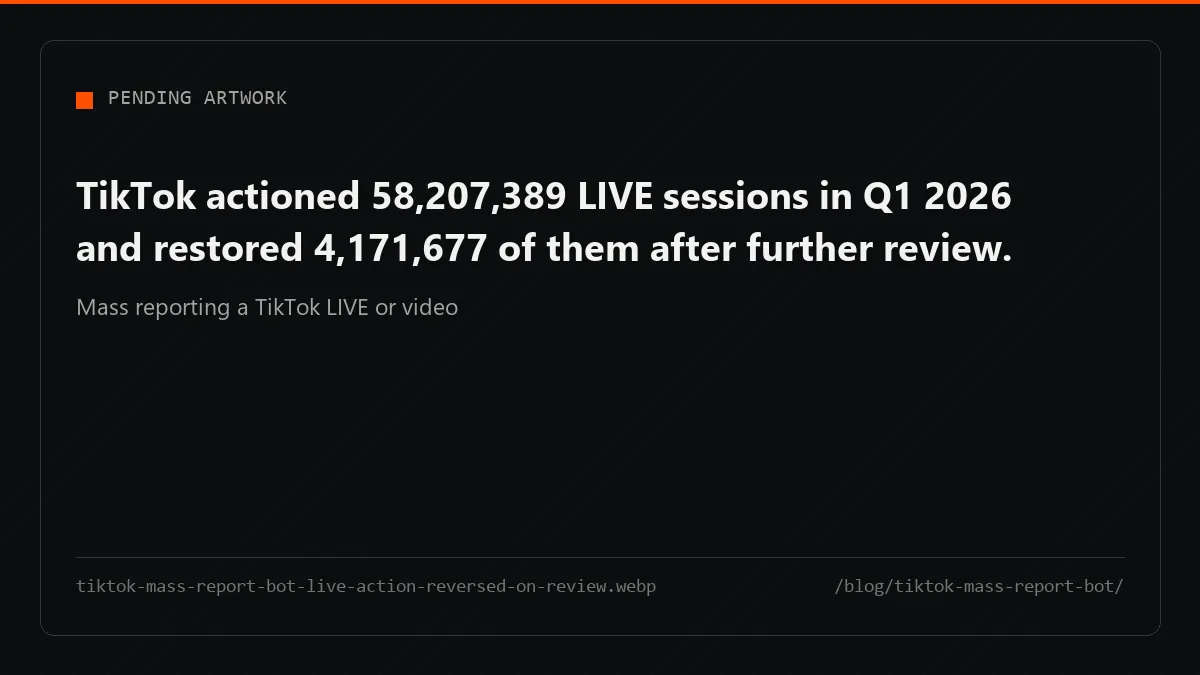
TikTok actioned 58,207,389 LIVE sessions in Q1 2026 through warnings or demonetisation, and restored 4,171,677 of them after further review — 7.2% reversed.TikTok Community Guidelines Enforcement Report, Q1 2026.
A reversal rate of that size tells a streamer something specific. LIVE enforcement is often provisional, applied quickly and then re-examined, so an interruption during a hostile stream is not the end of the case. It also tells the buyer of a mass report TikTok live package that the mechanism being sold produces, at best, a temporary interruption that review can undo.
Reporting a LIVE legitimately uses the flag icon inside the stream, once, against the rule actually broken. A mass report TikTok tool aimed at a stream is buying repetition of that single tap.
If a campaign was aimed at your account
An account restricted or banned after a coordinated wave of false reports is appealing a false positive, not arguing a policy. The appeal turns on evidence that the enforcement was a mistake: proof of ownership, proof the content does not match the guideline TikTok cited, and any visible record of the campaign. File once, in the first 48 hours, before the account’s own record grows.
This is the case every vendor result on this search skips, and the one that arrives as real casework. TikTok’s own numbers are the most useful thing an appellant can know, because they establish that reversal is a normal outcome rather than a favour.
| Q1 2026 enforcement | Actioned | Restored on review | Reversal rate |
|---|---|---|---|
| Videos removed, global | 184,012,576 | 8,838,710 | 4.8% |
| LIVE sessions actioned, global | 58,207,389 | 4,171,677 | 7.2% |
| Videos removed, one market (Sri Lanka) | 441,089 | 20,051 | 4.5% |
Reversal rates calculated by Clearline from TikTok’s published Q1 2026 figures. The market-level row is included to show the ratio holds outside the global aggregate.Derived from TikTok Community Guidelines Enforcement Report, Q1 2026.
Roughly one removal in twenty is undone. That is low enough to be honest about and high enough to be worth filing properly, and it is why the content of a single appeal matters more than the number of times it is submitted. Ownership signals from outside TikTok do most of the work: a website linking to the account, an older archived copy of the profile, ad billing records, a matching handle elsewhere.
Our account recovery casework covers what platforms accept as ownership evidence and where a route genuinely runs out. The triage step that comes before any of it is described in how Clearline works.
What actually removes a TikTok account or video
Four routes remove content from TikTok, and volume is not one of them. A guideline report against content that genuinely breaks a named rule. An impersonation claim against an account using someone’s identity. A copyright notice against a copy of material you own. A court order, where the harm is defamation or another claim TikTok will not assess itself. Which of those runs on a deadline and which waits in a queue is separated in the three TikTok removal clocks.
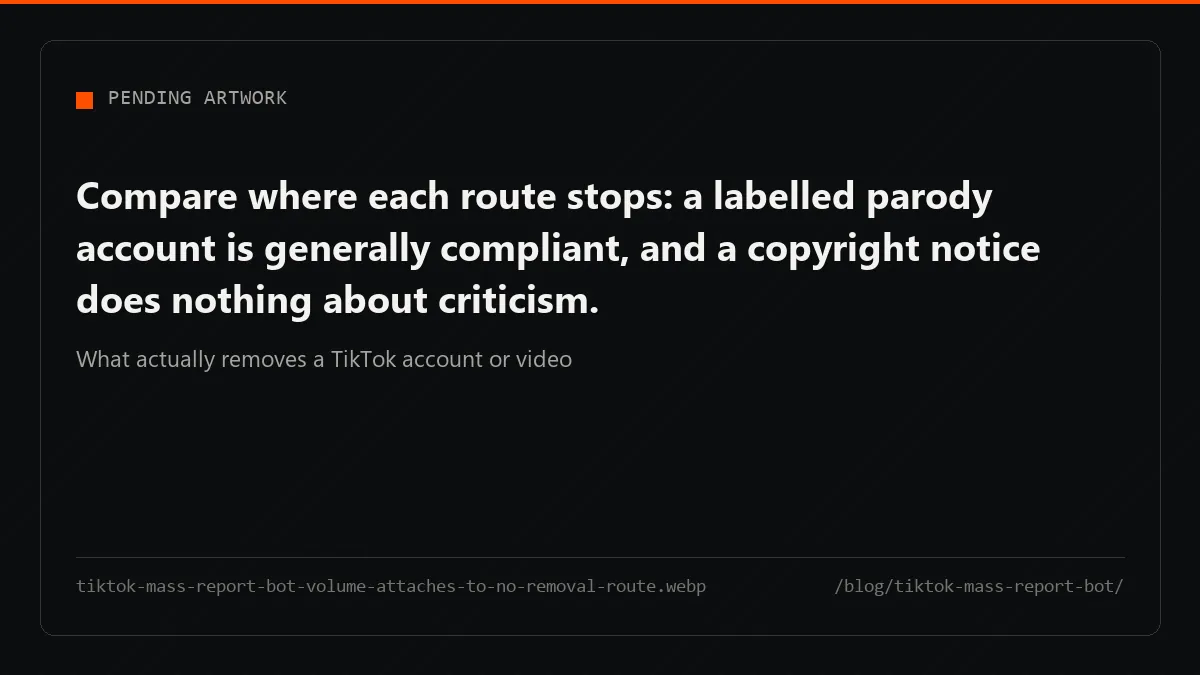
| Route | What it needs | Where it stops |
|---|---|---|
| Guideline report | The specific rule broken, evidence, and the account rather than one video | Closes with no action when the content does not breach the rule as written |
| Impersonation claim | Proof of identity, plus the account’s use of your name, likeness or photos | A labelled parody or fan account is generally compliant |
| Copyright notice | Ownership of the original, the URL of the copy, and a complete notice | Does nothing about commentary, criticism, or material you do not own |
| Court order | A judgment or order naming the specific content | Slow, expensive, jurisdiction-bound, unavailable for most disputes |
Removing a TikTok video and removing it from search become two separate jobs once a copy has been reposted or indexed. The second follows the evidence discipline set out in the guide to removing personal details from Google results, and the realistic ranges for each request type are broken down in how long content removal takes.
The report-selling market runs the same playbook on every platform. Its pricing and failure mode on X are documented in our look at why a Twitter mass report bot changes nothing, and the managed version of the same offer is examined in what an Instagram ban service actually sells. The equivalent audits against each platform’s own published figures cover YouTube flag volume and WhatsApp grievance reports. Clearline files removal and recovery requests and declines campaigns against third parties — the three casework tracks each state their own limits, including source-level removal.
Frequently asked questions
Does mass reporting work on TikTok?
No. TikTok assesses each report against the specific Community Guideline it names, and settles the case on the content rather than on the number of complaints. TikTok’s Q1 2026 enforcement report shows 99.3% of removed videos were found before any user reported them, so reports of any volume compete for a small remainder of enforcement.
Can a TikTok mass report bot get my own account banned?
Yes. TikTok’s Harassment and Bullying guideline prohibits inciting harassment or promoting coordinated abuse, and gives falsely reporting an account as an example. Because the rule targets organising rather than reporting, it reaches the buyer and the group. TikTok also states it may ban all of an offender’s accounts, which covers a pool of accounts running a bot.
How many reports does it take to ban a TikTok account?
There is no number. TikTok bans accounts for repeated violations, a single severe violation, evading enforcement, or running accounts dedicated to breaking the rules. None of those triggers is a report count. One accurate report on a genuine violation can lead to removal, and ten thousand from a TikTok mass report bot against compliant content lead to none.
Is a TikTok mass report bot APK or GitHub repository safe to run?
No. A TikTok mass report bot apk or repository needs a logged-in session to file anything, so it asks for your TikTok credentials or a session token. Handing those over gives the operator the account, not the target’s. The safest reading of any build that requests a login is that account access is the product being collected.
Can you mass report a TikTok live stream or video into removal?
No. TikTok actioned 58,207,389 LIVE sessions in Q1 2026 and restored 4,171,677 of them on review, which shows LIVE decisions are reversible findings about content rather than tallies of complaints. Reporting a LIVE through the flag icon inside the stream, once, against the rule actually broken, is the strongest action a viewer has.
My TikTok account was banned after a mass reporting campaign. What now?
Appeal once, quickly, and argue that the enforcement was a mistake rather than that the rule is unfair. TikTok reinstated 8,838,710 of the 184,012,576 videos it removed in Q1 2026, about 4.8%, so reversal is real but uncommon and turns on evidence. Lead with proof of ownership and proof the content does not match the guideline TikTok cited.
Banned after a wave of false reports?
Send the notice TikTok sent you and the date it arrived. You get an assessment of which appeal route applies, what evidence it needs, and whether one exists at all.
Related guides
- Twitter mass report bot: volume does not ban X accounts
- Instagram spam report bot: what works and what fails
- Instagram ban service: what it sells and what works
- Mass report Instagram account: what actually happens
- Snapchat mass report: what Snap acts on
- Telegram ban service: what the quote buys
- WhatsApp ban service: cost, routes and real odds
- YouTube ban service: the quote against YouTube’s published rules
- How long does content removal take? Timelines by request type
- How to remove personal information from Google search results
- Content removal casework and its limits
- Account recovery: evidence, routes and realistic outcomes
- Reputation management and search suppression
- All three casework tracks
- Every Clearline guide, newest first
- About Clearline Reputation
- Devin Marsh: profile and editorial standards
- Contact and case review
- Privacy policy
- Terms of service
- Clearline Reputation: removal, suppression and account recovery